Your Door-to-Door Sales Team Isn’t Losing Because of Bad Reps: 7 Problems to Fix


A rep misses target. The manager blames the rep. The rep blames the territory. The manager changes the rep. Three months later, the numbers are still bad.
Maybe the rep was never the real problem.
A door-to-door sales team can have hardworking, capable reps and still struggle because of poor territory planning, weak follow-up, limited field visibility, unclear performance metrics, or inefficient sales processes.
Before replacing another salesperson, managers should look at the system around that salesperson.
Why Door-to-Door Sales Teams Underperform
Managing a D2D sales team is different from managing an office-based sales team. Reps spend most of their day away from the manager, moving through territories, speaking with prospects, recording leads, scheduling follow-ups, and trying to close deals.
That makes it easy for problems to go unnoticed.
A rep might be working a weak territory. Two reps might be covering the same area. A promising lead might never receive a follow-up. A manager might only discover the problem when the weekly sales numbers arrive.
The first step to improving D2D sales performance is finding where the process is actually breaking down.
1. Your Reps Might Be Working the Wrong Territory
Territory management is more than drawing lines on a map.
The territory determines how many potential customers a rep can reach, how much time they spend travelling, which neighborhoods they cover, and whether an area has already been worked by another rep.
Poor territory management can lead to overlapping assignments, wasted travel time, uneven opportunities, and neighborhoods being left untouched.
That can also create a misleading performance picture.
If one rep is working a high-demand neighborhood while another spends most of the day travelling through a low-response area, comparing their sales numbers without considering territory quality doesn't tell the whole story.
Managers should know which territories are assigned, which have been covered, and which areas are producing the best results.
2. You Can't Manage What You Can't See
A D2D manager cannot follow every rep throughout the day.
If the only information available is that a rep "knocked 80 doors," there are still important questions left unanswered.
How many people answered? How many conversations happened? How many leads were generated? Which prospects requested a callback? Which part of the territory was covered?
Without that information, coaching becomes guesswork.
Field-sales software can give managers better visibility into territory coverage, activity, leads, and performance without requiring reps to spend hours creating reports.
The goal isn't to watch every move a rep makes. It's to understand what is happening in the field well enough to make better decisions.
3. Your Best Leads Might Be Dying After the First Conversation
A homeowner says they're interested but want to think about it. Another asks the rep to come back next week. Someone else wants more information before making a decision.
None of those prospects are necessarily lost.
But without a proper follow-up process, they can easily become lost.
When lead information is scattered across notebooks, spreadsheets, messages, and individual phones, it becomes harder to know which prospects still need attention.
A better D2D workflow connects the first conversation to the next action. Reps should be able to record what happened, categorize the lead, schedule a follow-up, and track the outcome.
The first knock is only the beginning of the sales process.
4. Stop Measuring D2D Teams by Sales Alone
Sales are important, but they don't always explain why a team is winning or losing.
Think about the basic D2D funnel:
Doors → Conversations → Qualified Leads → Appointments → Sales
Each stage tells you something different.
If a rep knocks plenty of doors but gets very few conversations, look at the territory, timing, or approach.
If conversations are high but qualified leads are low, the pitch or qualification process may need work.
If qualified leads are high but appointments are low, follow-up could be the problem.
If appointments are high but closes are low, the issue may be the offer, presentation, objection handling, or closing process.
This gives managers something specific to coach instead of simply telling a rep that their numbers are bad.
5. More Doors Doesn't Always Mean Better Performance
More activity can create more opportunities, but activity alone doesn't tell you whether a rep is performing well.
Imagine Rep A knocks 150 doors and generates two qualified leads. Rep B knocks 90 doors and generates 10 qualified leads.
If you only measure doors knocked, Rep A looks better.
Once you look at conversion, the picture changes.
Useful D2D metrics can include doors knocked, conversations, qualified leads, appointments, follow-up activity, conversion rate, revenue, and territory coverage.
The exact benchmarks will vary by industry and sales process. What matters is knowing where prospects are dropping out of the funnel.
6. Your Managers Might Be Coaching From Opinions Instead of Data
One of the easiest mistakes for a sales manager to make is assuming they already know why a rep is struggling.
Maybe the rep isn't working hard enough. Maybe they need better training. Maybe they're struggling with objections. Maybe the territory is poor.
Without data, those are assumptions.
Consider two reps who each make five sales in one week. One knocked 250 doors while the other knocked 80.
Those reps should probably receive different coaching.
The first may need help improving conversion. The second may need help increasing activity or getting more from the territory.
Looking at sales, activity, territory, and conversion together gives managers a much clearer picture.
7. Commission Problems Can Create Unnecessary Friction
Commission is a major part of many D2D sales operations, so inaccurate or unclear tracking can quickly become a problem.
If reps constantly have to ask which sales count, how much they are owed, or why a deal is missing, management is spending time solving problems that should already be handled by the system.
A more organized process can connect sales activity, deals, commissions, and payouts so both managers and reps have a clearer view of performance.
That creates less confusion and lets reps focus on selling.
What a Better D2D Sales System Looks Like
A strong D2D operation gives managers visibility without creating unnecessary work for reps.
Managers should be able to see which territories are being worked, what is happening in the field, which prospects need follow-up, how individual reps are performing, and where prospects are dropping out of the sales process.
Reps need the same system to be simple enough to use while they're actually in the field.
That means fast mobile lead capture, territory information, door tracking, follow-up management, and easy access to the information they need.
The technology should support the sales process, not become another administrative burden.
Can Software Fix a Bad D2D Sales Team?
No.
Software won't turn a poor salesperson into a great one. It won't fix a weak offer or replace sales training.
What it can do is remove some of the operational problems that make good teams harder to manage.
The right system can improve field visibility, organize territories, track leads and follow-ups, measure performance, and give managers better information for coaching.
Software isn't the sales strategy. It's the infrastructure supporting it.
Where Turtle Sales Fits
Turtle Sales is built for teams that sell in the field, particularly door-to-door and outside sales teams.
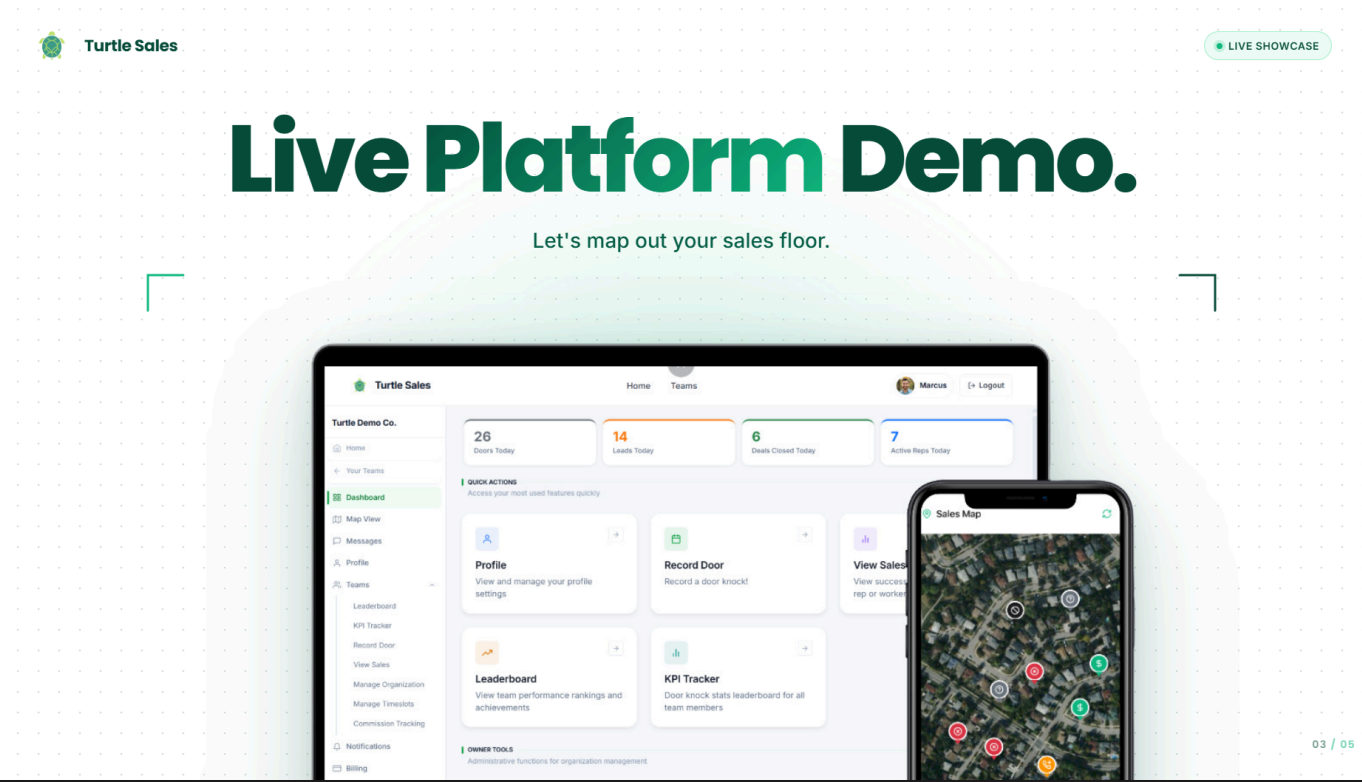
It brings important parts of the field-sales process together, including territory management, door and activity tracking, lead management, team performance, commissions, scheduling, and communication.
Instead of piecing information together from spreadsheets, maps, messages, and separate tools, managers can get a clearer view of what is happening across their team.
The real value isn't simply having another sales app.
It's being able to connect what happens in the field with what happens on the sales dashboard.
When a team is underperforming, that visibility can help managers answer a better question than, "Which rep should we replace?"
It can help answer:
Where is the sales process actually breaking down?
Before You Blame Your D2D Reps, Check These 7 Things
Before replacing a struggling rep, check the territory, activity, follow-up, conversion, coaching, and operations.
Is the territory giving the rep enough opportunity? Is the area actually being worked? Are interested prospects being followed up with? Where are prospects dropping out of the funnel? Does the manager have enough information to coach the rep properly? Are leads, territories, sales, and commissions being tracked clearly?
If several of these areas are broken, replacing the rep may simply move the same problem to someone else.
Frequently Asked Questions
Why do door-to-door sales teams underperform?
D2D teams can struggle because of poor territory allocation, weak follow-up, limited field visibility, ineffective coaching, unclear metrics, or inefficient sales processes. Low sales numbers do not always identify the actual problem.
How can I improve my door-to-door sales team's performance?
Start by identifying where the sales process is breaking down. Review territory performance, track activity and conversion, improve lead follow-up, and use field data to identify specific coaching opportunities.
What should a D2D sales manager track?
Useful metrics include doors knocked, conversations, qualified leads, appointments, follow-up activity, conversion rate, sales, revenue, and territory coverage.
How do you manage door-to-door sales reps effectively?
Effective D2D management combines clear territory assignments, measurable targets, consistent coaching, lead follow-up, performance tracking, and accurate commission management.
Can door-to-door sales software improve team performance?
Software cannot replace good salespeople or management, but it can improve field visibility, organize territories, track leads and follow-ups, and make performance data easier to use.
Final Takeaway
A struggling door-to-door sales team doesn't automatically need new salespeople.
Sometimes it needs better territories. Sometimes it needs better follow-up. Sometimes managers need better data. Sometimes the sales process itself needs to be fixed.
The first step is finding the real problem.
Before replacing the next struggling rep, look at the system around them.
The problem might not be the person knocking the doors.
It might be everything happening between the first knock and the final sale.