Best Door-to-Door Sales Software to Knock More Doors in 2026
Why Door-to-Door Sales Software Is a Different Category From a Traditional CRM
The instinct to solve field sales with a general-purpose CRM is understandable. You may already pay for one. It has contacts, deals, and reporting. Why buy a second system?
Because the unit of work is different. A traditional CRM is organized around an account that a rep touches over weeks through email, calls, and meetings. A door-to-door operation is organized around a geographic area that a rep physically walks, where the primary event is a 30-second interaction with a stranger who may never become a record at all.
The desktop CRM problem in the field
Watch what actually happens when a canvassing team is issued a standard field sales CRM:
- Data entry is deferred. Reps knock all day and try to reconstruct 80 doors from memory at 9 p.m. Roughly none of that is accurate.
- Non-contacts vanish. Most CRMs only want records for real leads, so "no answer" and "not home," the majority of every shift, never get captured. That's precisely the data you need for re-canvassing.
- Connectivity is assumed. Basements, rural routes, new construction, and parking garages all break a cloud-only app.
- The map is an afterthought. If mapping exists at all, it's a plotted list of existing contacts, not a live working surface you can draw turf on.
- Every rep costs money. Per-seat pricing punishes exactly the hiring pattern D2D teams depend on. More on this below, because it's the quiet killer.
The result is a system that management loves in the demo and reps abandon by week three.
What "field-native" actually means
Purpose-built mobile field sales software inverts the design priorities. The map is the home screen. Logging a door is one tap, not a form. The app assumes you're offline and syncs when you're not. Non-contacts are first-class data, because knowing that 40 houses on Maple Street were "no answer" at 2 p.m. Tuesday is a plan for Thursday evening.
The distinction matters commercially, not just philosophically. Nucleus Research's widely cited analysis of mobile CRM adoption found that 65% of salespeople using a mobile CRM hit their quota, compared with 22% of those who don't. Giving reps mobile access to their CRM also lifted productivity by roughly 14.6%. Mobile access isn't a convenience feature in field sales. It's the whole product.
The Time Problem: What the Data Says About Field Sales Efficiency
Before evaluating features, it's worth being precise about the problem you're solving. It is almost never "our reps don't work hard enough." It's that a large share of their paid hours never reaches a doorstep.
SPOTIO's 2026 State of Field Sales research found that field reps spend only about 43% of their time actually selling, with 21% of the working week consumed by administrative work and data entry, which works out to roughly eight hours per rep, per week. Across sales roles generally, Salesforce's 2025 State of Sales report puts direct selling time even lower, at roughly 28–30% of the week.
Run that math on a ten-person canvassing team. Eight admin hours per rep per week is 80 hours weekly, more than 4,000 hours a year, an entire additional headcount's worth of time spent on activity that generates zero pipeline.
The point isn't that admin work disappears with good software. It's that most of it is transcription: copying what happened at a door into a system that should have captured it automatically. Every one of the features below is, at bottom, an attempt to delete transcription.
The 7 Features That Define the Best Door-to-Door Sales Software
Use this as a scoring rubric. A serious platform does all seven; most tools marketed to D2D teams do three or four and hope you don't notice.
1. Interactive territory mapping
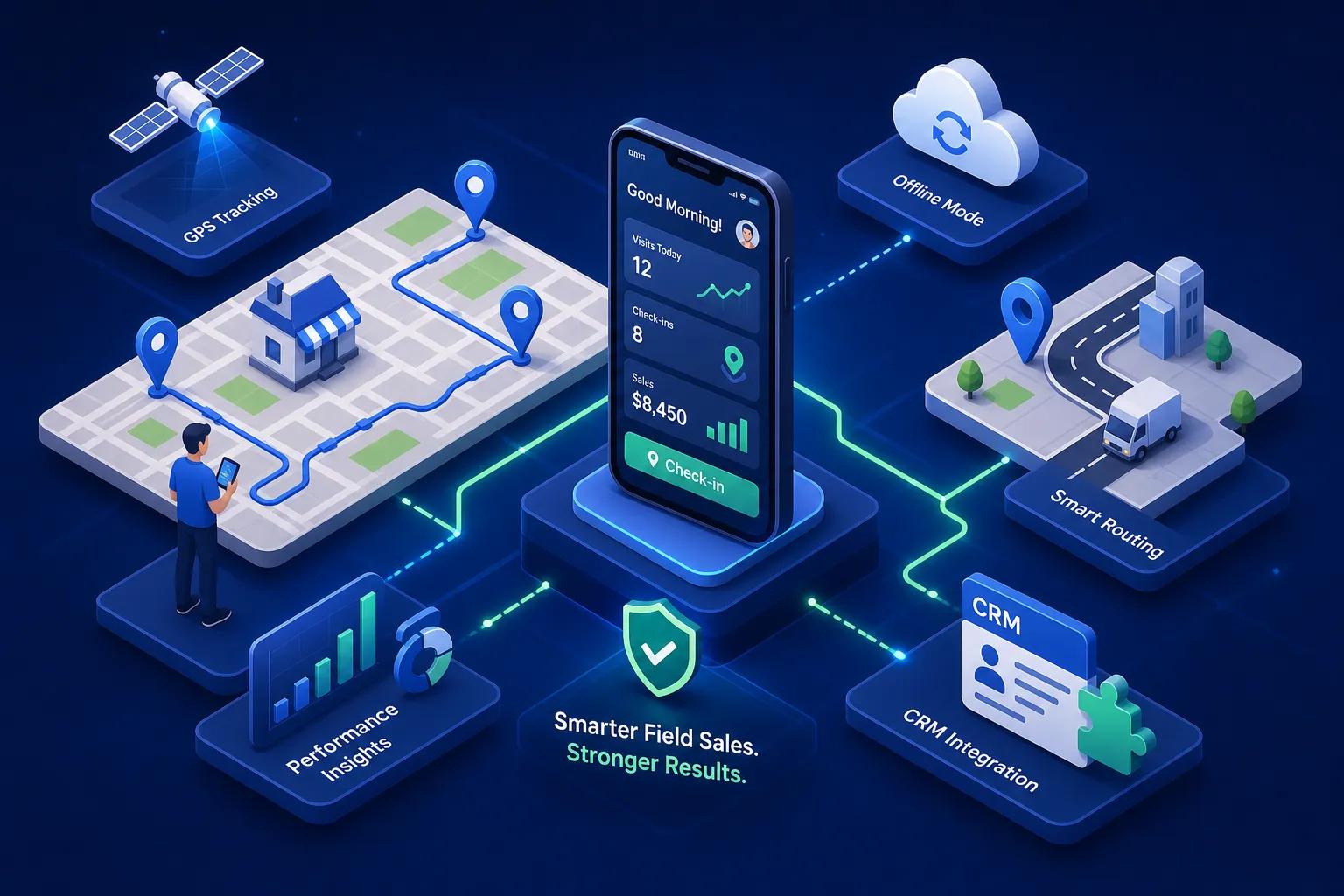
A live satellite map where you can draw boundaries, assign them to reps, and see color-coded pins for every door. This is the backbone. If mapping is a tab rather than the home screen, the product is a CRM wearing a costume.
Non-negotiables: drawable polygon turf, per-rep assignment, satellite and street views, pin color by disposition, and visible territory borders on the rep's phone so nobody wanders into someone else's street.
2. One-tap door logging
Every house gets a pin and a status in a single gesture: Sale, Callback, No Answer, Not Interested, Do Not Knock. If logging a door takes longer than the walk to the next one, reps will batch it, and batched data is fiction.
3. Offline-first architecture
The app must record doors with no signal and sync silently on reconnect. This is a hard architectural requirement rather than a nice-to-have, and it's the single most common reason field deployments fail in rural and new-construction territories.
4. Lead tracking and follow-up discipline
Lead tracking in D2D is mostly callback management. A pin marked "callback, Thursday 6 p.m." needs to become a scheduled, assigned, notified task. Most revenue lost in canvassing isn't lost at the door. It's lost in the 72 hours after a warm conversation that nobody returned to.
5. Commission tracking and payout reporting
Door-to-door compensation is complex: tiered rates, self-gen bonuses, clawbacks on cancellations, split deals. When commissions are calculated in a spreadsheet, two things follow: payroll errors, and reps who quietly stop trusting the numbers. Automated calculation tied to logged sales removes an entire recurring argument from your week.
6. Leaderboards, KPIs, and analytics
Real-time leaderboards work in D2D because the culture is genuinely competitive. But the coaching value is in the ratios beneath the leaderboard: knocks → contacts → pitches → closes.
7. Team communication and scheduling
Group chat, workday scheduling, and availability management inside the same app that holds the map. Every tool you push to a separate app is a tool half your team won't open.
Territory Mapping Software: The Highest-Leverage Feature Most Teams Underuse
Most teams adopt territory mapping software to answer one question (where is everybody?) and stop there. That's the least interesting thing a map can do.
Turf cutting that reflects reality, not zip codes
Zip codes are postal routing artifacts. They don't correspond to housing density, income, roof age, HOA rules, or build year, all of which drive conversion. Draw turf around what actually predicts a sale.
A roofing company after a hailstorm is the cleanest example. Insurance claim viability follows the storm's path, which cuts across postal boundaries at an angle. A team drawing polygons along the actual damage corridor works a materially different, and much better, set of streets than a team assigned "the 30301 zip."
Assignment and accountability without micromanagement
Assigned polygons solve three problems at once: reps stop double-knocking the same houses, "Do Not Knock" designations are respected across the whole team rather than living in one rep's memory, and managers can verify coverage without asking anyone to justify their day. The map answers the accountability question so the conversation can be about technique instead.
Re-canvassing: where the compounding actually happens
Here's the strategic payoff. On a typical shift the large majority of doors are "no answer." In a clipboard operation that effort evaporates. In a mapped operation it becomes an asset.
A solar team in a commuter suburb logs 400 doors on a Tuesday afternoon; 260 are no-answers. Instead of assigning fresh territory Thursday, the manager filters the map for no-answer pins in that polygon and sends two reps back between 5:30 and 8 p.m. Same streets, different population: the people who were at work. Contact rate on that second pass typically runs well above a cold first pass, because the addresses are pre-qualified as occupied and unworked.
That single workflow (filter, re-route, re-knock) is usually worth more than every other feature combined, and it is impossible without disposition-level pin data.
From Knock to Close: Building a Lead Pipeline That Doesn't Leak
A canvassing app captures the top of the funnel. Revenue depends on what happens in the next 72 hours.
Standardize your disposition taxonomy first
Before rollout, define your statuses and their exact meanings, then don't allow ad-hoc variants. A workable baseline:
- Sale: signed, with the agreement attached.
- Callback: real interest, specific return time committed.
- Not Interested: spoken to, declined.
- No Answer: nobody home, eligible for re-canvass.
- Do Not Knock: permanent exclusion, visible team-wide.
Five statuses everyone applies identically beats fifteen everyone interprets differently. Your entire reporting layer inherits the quality of this decision.
Put a clock on every callback
Treat callbacks as time-bound commitments with an owner and a deadline, surfaced on the rep's schedule rather than buried in the map. A pest control team that instituted a simple rule (every callback gets a scheduled slot within 48 hours, and unscheduled callbacks escalate to the manager on day three) converts a category of lead that most teams silently abandon.
Make the handoff to fulfillment explicit
The moment a sale closes, the record has to reach install, service, or scheduling with the address, contact details, and any commitments the rep made. Sales that die between "signed" and "installed" are the most expensive kind: you paid full commission and acquisition cost for a cancellation. Whatever platform you choose should make that handoff a state change, not an email.
Sales Team Management: Coaching With Data Instead of Anecdotes
The highest-ROI use of sales team management software isn't surveillance. It's diagnosis.
Leading indicators beat lagging ones
Revenue tells you what happened last month. The ratio stack tells you what to fix today:
- Knocks per shift: effort and territory quality
- Contact rate (contacts ÷ knocks): timing and territory selection
- Pitch rate (pitches ÷ contacts): the opener
- Close rate (sales ÷ pitches): the pitch and objection handling
- Cancellation rate: qualification honesty
Diagnose the specific broken link
Two underperforming reps with identical sales numbers usually need opposite coaching, and only the ratios reveal which:
Rep A logs 120 knocks a shift with a 9% contact rate. He isn't a pitch problem. He's a timing problem. He's knocking a commuter neighborhood at 1 p.m. Move his shift, and his numbers move.
Rep B logs 60 knocks with a 38% contact rate and a 4% close rate. She's getting conversations and losing them. She needs objection-handling reps, not a schedule change.
Without door-level data, both of these look like "needs to work harder," and both get the same useless pep talk.
An illustrative rollout scenario
The following is an illustrative composite, not a named customer, meant to show the shape of the return:
A 12-rep home services team moves off spreadsheets onto a mapped platform. In the first month, the visible changes are unglamorous: duplicate knocks drop because turf is assigned, and commission disputes stop because payouts are calculated from logged sales rather than reconstructed weekly. By month two the manager starts running Thursday-evening re-canvass passes over Tuesday's no-answer pins, and begins coaching two reps off their ratio profiles rather than their totals. Revenue per rep moves not because anyone worked longer hours, but because the same hours were pointed at better doors and the follow-up stopped leaking.
That's the realistic mechanism. Nobody knocks more doors. The doors just get chosen, logged, and revisited on purpose.
The Hidden Cost of Per-Seat Pricing in Door-to-Door Sales
This section is about pricing structure, and it deserves more attention than it usually gets, because it determines whether your rollout survives contact with reality.
Per-seat pricing is misaligned with how D2D teams operate
Door-to-door is seasonal and high-churn by nature. Summer programs triple headcount. New reps wash out in the first three weeks. Recruits shadow before they produce. A per-seat model taxes every one of those normal, healthy patterns:
- You ration seats. New hires wait for a license, so their first two weeks of data, the most coachable period of their tenure, never gets captured.
- You keep ghost seats. Nobody remembers to deprovision the rep who quit in June, and you pay for them until the annual renewal.
- Your recruiters and setters stay outside the system, because adding them isn't worth the line item.
- Scaling is penalized. Every hire raises software cost at exactly the moment cash is tightest.
The compounding damage is to data quality. A platform that only some of your team is on produces reporting nobody fully trusts, which sends managers back to spreadsheets. And once the spreadsheet returns, the software is functionally dead.
What a flat rate changes behaviorally
No per-seat pricing removes the decision entirely. Everyone goes on day one: reps, setters, closers, recruits, part-timers, the office manager. Your dataset is complete because there was never a reason to exclude anyone.
Run the comparison. At a fairly typical $25–$40 per seat per month, a 20-person team pays roughly $500–$800 monthly, or $6,000–$9,600 a year, and that bill grows every time you hire. Turtle Sales charges one flat rate of $70 CAD per month for the entire organization, up to 25 members, with 6-month and annual terms available at a discount. The 20th rep costs the same as the second: nothing.
The financial argument is obvious. The operational argument is better: flat pricing is what lets you put everyone on the map, and complete data is the precondition for every other benefit in this guide.
How to Evaluate and Roll Out a Canvassing App in 30 Days
Software selection is the easy half. Adoption is where deployments die.
The evaluation checklist
Score every vendor on these, and weight the first four heaviest:
- Native iOS and Android apps, not a mobile-responsive web page in a wrapper
- Offline door logging with automatic sync
- Drawable territory polygons with per-rep assignment
- One-tap disposition logging from the map view
- Callback scheduling tied to a rep's workday
- Automated commission calculation and pay-period reports
- Leaderboards and ratio-level KPIs, not just totals
- Role-based access so reps see their turf and managers see everything
- Flat-rate pricing with no per-seat fees
- Data export, so your history is portable
A realistic 30-day rollout
Week 1: Configure. Lock your disposition taxonomy. Draw your first territories. Set commission rules. Import your Do Not Knock list before a single rep logs in; nothing damages credibility faster than knocking a household that already opted out.
Week 2: Pilot. Put your two or three best reps on it. They'll surface the workflow gaps, and more importantly, their endorsement carries weight the manager's never will.
Week 3: Full team. Train in 20 minutes, not two hours. If it needs a long training, it's the wrong tool. Make the rule unambiguous: every door gets a pin, every shift. Managers work exclusively from the platform starting now.
Week 4: Close the loop. Run your first re-canvass pass off no-answer pins. Run commissions through the platform. Hold one coaching conversation per rep using their ratio stack. This is the week the team stops seeing it as tracking software and starts seeing it as their map.
Adoption red flags to watch for
- Reps logging doors in bulk at end of shift → the logging flow is too slow, or you haven't made the "every door, every shift" rule real.
- Managers still maintaining a parallel spreadsheet → some report they need doesn't exist yet; find it and fix it, or the spreadsheet wins.
- Pin data thinning out after week three → the classic signal that reps see the tool as surveillance rather than as something that helps them earn. Fix it by showing them their own ratios and what changing one of them is worth in commission.
Where Turtle Sales Fits
Turtle Sales was built specifically for door-to-door teams rather than adapted from a general sales platform, which is the distinction this whole guide has been circling.
The center of the product is a live satellite sales map. Reps drop a color-coded pin at every house and record the outcome in one tap: Sale, Callback, No Answer, Not Interested, Do Not Knock. Managers draw territory boundaries and assign them, so everyone knows exactly which streets are theirs. It works offline and syncs when signal returns.
Around the map sit the operational pieces that usually live in three other tools: automated commission tracking with pay-period payout reports, a real-time leaderboard, a KPI hub for conversion and knock analytics, workday scheduling and availability, team messaging, role-based org structure, AI roof measurement, and native iOS and Android apps alongside a web dashboard for managers.
And the pricing follows the logic above: $0 forever for a solo rep who just wants a personal map with a pin for every door, and $70 CAD per month flat for an organization of up to 25 members, with no per-seat fees. Cancel anytime.
Frequently Asked Questions
What is the best door-to-door sales software for a small team?
The best door-to-door sales software for a small team is a field-native platform with interactive territory mapping, one-tap door logging, offline capability, and flat-rate pricing rather than per-seat fees. Small teams should prioritize speed of adoption over feature depth. A tool reps actually use every shift produces far more value than a comprehensive CRM they abandon. Turtle Sales is built for this case, with a free plan for solo reps and a flat $70 CAD per month for organizations up to 25 members, so adding a rep never increases your software cost.
How is a canvassing app different from a regular CRM?
A canvassing app is organized around a map and a territory; a regular CRM is organized around accounts and a pipeline. A canvassing app captures every door, including "no answer" and "not interested," because that non-contact data drives re-canvassing strategy, while a traditional CRM only wants records for qualified leads. Canvassing apps are also offline-first and optimized for one-tap logging on a phone, whereas most CRMs assume a laptop, a connection, and time to fill out form fields.
Does door-to-door sales software actually increase revenue?
It increases revenue by reallocating time and reducing leakage rather than by making reps knock more doors. SPOTIO's 2026 State of Field Sales research found field reps spend only about 43% of their time selling, with roughly 21% of the week lost to administrative work and data entry. Nucleus Research found that 65% of salespeople using a mobile CRM hit quota versus 22% of those who don't, and that mobile CRM access raised productivity by about 14.6%. The gains come from automated logging, disciplined callback follow-up, and data-driven re-canvassing of doors you've already paid to knock.
Why does per-seat pricing matter for door-to-door sales teams?
Door-to-door teams are seasonal and high-churn, so per-seat pricing penalizes normal operations: you ration licenses for new hires, pay for reps who've already quit, and leave setters and recruits off the system entirely. That produces incomplete data, which pushes managers back to spreadsheets and kills adoption. Flat-rate pricing with no per-seat fees lets you put the entire organization on the platform from day one, which is the precondition for trustworthy reporting.
Conclusion
Door-to-door still works. What no longer works is running it on a clipboard, a group text, and a CRM designed for someone sitting at a desk.
The teams pulling ahead in 2026 have made a few unglamorous decisions. They log every door instead of just the good ones, they draw territory around what predicts conversion instead of around zip codes, they treat no-answer pins as an asset to be re-worked rather than wasted effort, they coach from ratios instead of totals, and they put every single person on the platform because the pricing model never gave them a reason not to.
None of that requires knocking more doors. It requires knowing which doors, when, and what happened last time, which is precisely what the best door-to-door sales software exists to tell you. The eight hours a week your reps currently spend on administrative work is the budget you're spending it out of.
Start free with Turtle Sales
Draw your first territory today and see every door your team knocks on a live map.
- Solo reps: get a personal sales map with a pin for every door. Free forever, no credit card required.
- Teams: $70 CAD per month flat for your entire organization, up to 25 members. No per-seat fees. Cancel anytime.
- Native iOS and Android apps plus a full web dashboard for managers.
Most teams have their turf drawn and their first shift logged the same afternoon.